20 Places to Visit in Nepal

Discover the best places to visit in Nepal, from the Himalayan peaks and serene lakes to ancient temples and charming mountain towns. Explore Nepal’s natural beauty, rich culture, and unforgettable travel experiences.

Nepal Tourist Places

Nepal is a small Himalayan country wedged between India and China, but it packs an extraordinary range of landscapes, culture, and experiences into its modest size. From the world’s highest peak, Mount Everest, to dense subtropical jungles teeming with rhinos and tigers, and from centuries-old medieval towns to serene lakeside cities, Nepal offers something for every kind of traveller. Whether you’re a trekker chasing mountain views, a pilgrim seeking spiritual sites, a history buff drawn to UNESCO World Heritage monuments, or a family looking for a relaxed getaway, the places to visit in Nepal cover every interest imaginable.

For Indian travellers especially, Nepal is an easy, visa friendly, and budget-conscious destination that still feels wonderfully foreign, with its own language, cuisine, and Himalayan culture. Kathmandu’s ancient squares, Pokhara’s tranquil lakes, Chitwan’s wildlife safaris, and the high-altitude trails of the Everest and Annapurna regions are just a handful of the Nepal tourist spots that draw millions of visitors every year. Nepal also rewards travellers who venture beyond the obvious circuit, into tea gardens, hidden Newari towns, and remote mountain kingdoms.

  • Ghorepani

    Ghorepani

    Ghorepani is a picturesque hill village in the Annapurna Conservation Area, best known as the base for the sunrise hike to Poon Hill. Perched at roughly 2874 metres, it sits amid dense rhododendron forests that burst into colour each spring, forming sweeping views of the Annapurna, Dhaulagiri, and Machhapuchhre ranges. Once a resting stop for horse traders, it now thrives on trekking tourism, with cosy teahouses run by Gurung and Magar communities. Among the many places to visit in Nepal for short, rewarding treks, Ghorepani remains one of the most photographed.

    • Location: Myagdi District, Dhaulagiri Zone, within the Annapurna Conservation Area, reached via a multi-day trek from Nayapul or Pokhara.
    • Timings: Best visited during daylight trekking hours; the pre-dawn climb to Poon Hill typically begins around 4:30 am for sunrise.
  • Thamel

    Thamel

    Thamel is Kathmandu’s buzzing tourist quarter, a maze of narrow lanes lined with trekking gear shops, handicraft stores, bookshops, bars, and restaurants serving everything from Nepali thukpa to continental food. It has long served as the starting point for trekkers heading into the Himalayas and remains the city’s liveliest hub for nightlife and shopping. With its mix of budget guesthouses and boutique hotels, Thamel is one of the most convenient places to visit in Nepal for travellers who want culture, comfort, and chaos is one compact neighbourhood.

    • Location: Central Kathmandu, near Durbar Marg and the former Royal Palace.
    • Timings: Shops and restaurants generally operate from around 9 am to 11 pm; nightlife continues later in some venues.
  • Garden of Dreams

    Garden of Dreams

    The Garden of Dreams is a beautifully restored neo-classical garden in the heart of Kathmandu, built around 1920 for Field Marshal Kaiser Sumsher Rana and inspired by European landscape design. Also called Swapna Bagaicha, it features pavilions, fountains, sunken flower beds, and a large pond, offering a peaceful escape from the city’s traffic and noise. A short walk from Thamel, it is a favourite among couples and photographers. It is counted as the calmer places to visit in Nepal for travellers wanting a quiet break in Kathmandu.

    • Location: Tridevi Sadak, Kathmandu 44600, Nepal
    • Timings: 9 am to 9 pm
  • Bandipur

    Bandipur

    Bandipur is a beautifully preserved hilltop Newar town in central Nepal, often called the “Queen of the Hills”. Its vehicle-free cobbled streets are lined with 18th century trade-era buildings, carved wooden windows, temples, and courtyards that have changed little over the centuries. From the ridge, visitors get sweeping views of the Annapurna, Manaslu, Ganesh Himal, and Langtang ranges. Once a bustling stop on the Indian-Tibet trade route, it is now one of the most charming places to go in Nepal for travellers seeking heritage tourism without the crowds.

    • Location: Tanahun District, Gandaki Province, roughly midway between Kathmandu and Pokhara.
    • Timings: Best explored during daytime hours; the bazaar and temples are accessible throughout the day.

  • Panauti

    Panauti

    Panauti is an ancient Newari town at the confluence of the Roshi and Punyamati rivers, believed locally to be joined by a third, invisible river. Its centerpiece is the Indreshwar Mahadev Temple, dated to the late 13th century and considered the oldest surviving pagoda-style temple in Nepal. The town’s wood-carved houses, courtyards, and Durbar Square have earned it a reputation as a living museum of Newari craftsmanship. For travellers exploring lesser-known places to see in Nepal, Panauti offers an authentic, uncrowded alternative to the busier valley towns.

    • Location: Kavrepalanchok District, about 32 km southeast of Kathmandu.
    • Timings: Open year-round; temple areas are best visited during daylight hours.
  • Bhaktapur

    Bhaktapur

    Bhaktapur, the ancient city of devotees, is one of the three royal cities of the Kathmandu Valley and a UNESCO World Heritage Site. Its Durbar Square is home to the 55-Window Palace, the Golden Gate, and the towering Nyatapola Temple, alongside Pottery Square and Taumadhi Square, where potters and artisans still work using traditional techniques. Bhaktapur’s red-brick streets and wood-carved architecture have earned it recognition as one of the best-preserved medieval towns in South Asia, and it remains among the most visited Nepal tourist places for culture and heritage.

    • Location: Bhaktapur District, about 12-14 km east of Kathmandu.
    • Timings: The old city is accessible all day
  • Sarangkot

    Sarangkot

    Sarangkot is a hilltop viewpoint above Pokhara, famous as one of the best places in Nepal to watch sunrise over the Himalayas. From its viewing tower, visitors can see the Annapurna range, Dhaulagiri, and the fishtail peak of Machhapuchhre, along with Phewa Lake and the Pokhara Valley below. The hill is also a major launch site for paragliding, drawing adventure travellers alongside sunrise-chasers. Easily reached from Lakeside Pokhara, Sarangkot ranks among the most rewarding Nepal tourist attractions for travellers who want mountain views without a multi-day trek.

    Location: Kaski District, about 5-11 km northwest of Pokhara.

    Timings: The viewpoint is generally accessible from around 5 am to 8 pm; sunrise visit begin before dawn

  • Upper Mustang

    Upper Mustang

    Upper Mustang, once the independent Kingdom of Lo, is a high-altitude desert region bordering Tibet, opened to foreign visitors only since 1992. Walled by red cliffs and dotted with centuries-old monasteries, cave dwelling, and the ancient capital of Lo Manthang, it preserves a Tibetan Buddhist culture largely untouched by modern change. Because it lies in a restricted area, travel here requires a special permit and a registered guide. For travelers seeking remote, culturally rich Nepal sightseeing places, Upper Mustang remains one of the most extraordinary regions in the country.

    • Location: Mustang District, Gandaki Province, north of the Annapurna and Dhaulagiri ranges.
    • Timings: Best visited between March and November
  • Ilam

    Ilam

    Ilam, often called the “Tea Capital of Nepal,” is a lush hill district in the far east of the country, famous for its rolling tea gardens and cool, misty climate. The Kanyam and Ilam tea estates offer guided walks through plucking fields, tea-tasting sessions, and views of terraced hillsides framed by forests and streams. Nearby Antu Danda and Mai Pokhari add sunrise views and biodiversity to the mix. Often overlooked by first-time visitors, Ilam is one of the most refreshing places of Nepal to visit for slow, nature-focused travel.

    • Location: Ilam District, Koshi Province, in far-eastern Nepal near the Indian border.
    • Timings: Tea gardens and viewpoints are generally open through daylight hours; best visited October-December or February-April.
  • Jomsom

    Jomsom

    Jomsom is the administrative headquarters of Mustang District and the gateway to both Lower and Upper Mustang. Set in the dramatic Kali Gandaki Gorge, one of the deepest in the world, the town is flanked by the Annapurna and Dhaulagiri massifs and known for its strong afternoon winds. It served as a key stop for trekkers heading to Muktinath, Kagbeni, and beyond, and is well connected to Pokhara by road and short mountain flights. Jomsom is among the more distinctive Nepal tourist spots for high-altitude desert landscapes.

    • Location: Mustang District, Gandaki Province, along the Kali Gandaki River.
    • Timings: Accessible year-round, though flights are frequently affected by wind and weather; mornings are calmest for travel.
  • Nagarkot

    Nagarkot

    Nagarkot is a quiet hill station roughly 32 kms from Kathmandu, celebrated for its panoramic sunrise and sunset views over the Himalayan range, including distant glimpse of Everest on clear days. The laid back settlement is dotted with resorts and viewing towers that let visitors take in the scenery without leaving their hotel. Camping is also popular for those who want a different pace of travel. As one of the easiest Nepal tourist places for a short mountain-view getaway from the capital, Nagarkot suits both day-trippers and overnight visitors.

    • Location: Bhaktapur District, about 32 km east of Kathmandu.
    • Timings: The viewing tower and hillside points are open all day; sunrise viewing begins before dawn.

  • Sagarmatha

    Sagarmatha

    Sagarmatha National Park is a UNESCO World Heritage Site in eastern Nepal that protects the world’s highest mountain, Mount Everest, along with a dramatic landscape of glaciers, alpine forests, and Sherpa villages. Spanning elevations from around 2845 to 8848 metres, the park is home to rare wildlife such as the snow leopard and red panda, alongside cultural landmarks like the Tengboche Monastery. As the getaway to the Everest region, it stands as one of the most significant Nepal tourist points for both trekkers and nature enthusiasts.

    • Location: Solukhumbu District, Koshi Province, accessed via Lukla.
    • Timings: Open 24/7, but daylight visits are recommended; the trekking season runs March-May and September-November
  • Dhorpatan

    Dhorpatan

    Dhorpatan Hunting Reserve is Nepal’s only hunting reserve and one of its most remote protected areas, spread across the Baglung, Myagdi, and Rukum districts in the western Himalayas. Ranging in elevation from about 2850 to 5500 metres, it shelters blue sheep, Himalayan tahr, and goral amid rolling grasslands and alpine forests beneath the Dhaulagiri massif. The reserve also offers a rare glimpse into the lives of Tibetan refugee and hill-tribe communities settled in the valley. For adventurous travellers exploring off-beat Nepal travel places, Dhorpatan is a genuine wilderness escape.

    • Location: Baglung, Myagdi, and Rukum Districts, western Nepal.
    • Timings: Best visited between April and November.
  • Chitwan

    Chitwan

    Chitwan National Park, Nepal’s first national park and a UNESCO World Heritage Site, protects a stretch of subtropical grassland and forest in the Terai lowlands. It is home to more than 700 species of wildlife, including the endangered one-horned rhinoceros and the elusive Bengal tiger, along with hundreds of bird species. Visitors can explore the park on jeep safaris, canoe rides along the Rapti River, and guided jungle walks led by trained naturalists. Chitwan is consistently ranked among the top places to visit in Nepal for wildlife and nature lovers.

    • Location: Chitwan District, spanning parts of Nawalpur, Parsa, and Makwanpur, in south-central Nepal.
    • Timings: Park activities generally run from sunrise to sunset.

  • Khumbu Valley

    Khumbu Valley

    The Khumbu Valley is the heartland of the Everest region, home to the Sherpa people and gateway villages such as Namche Bazaar, Khumjung, and Tengboche. Framed by towering peaks and criss-crossed with suspension bridges, prayer flags, and monasteries, the valley combines high-altitude scenery with a rich mountaineering and Buddhist heritage. Namche Bazaar, the valley’s main hub, offers acclimatisation stops, bakeries, and gear shops for trekkers heading further into the mountains. Among the most adventurous Nepal travel places, Khumbu Valley anchors nearly every major Everest region trek.

    • Location: Solukhumbu District, within and around Sagarmatha National Park.
    • Timings: Best visited March-May and September-November; most villages are accessible only on foot or by air via Lukla.
  • Lumbini

    Lumbini

    Lumbini is the birthplace of Lord Buddha and one of Buddhism’s most sacred pilgrimage sites, located in the Terai plains of southern Nepal. Its Sacred Garden is marked by the Ashoka Pillar and the Maya Devi Temple, where excavations revealed the marker stone identifying Buddha’s exact birthplace. Surrounding the core site, the Lumbini Development Trust area houses monasteries and temples built by Buddhist countries from around the world. A UNESCO World Heritage Site since 1997, Lumbini is one of the most spiritually significant Nepal visiting places for tourists.

    • Location: Rupandehi District, Lumbini Province, in the Terai plains of southern Nepal.
    • Timings: The Sacred Garden and monastic zone are generally open through daylight hours.
  • Annapurna Valley

    Annapurna Valley

    The Annapurna region is one of Nepal’s most diverse trekking areas, ranging from subtropical lowlands to the high alpine terrain surrounding the Annapurna massif. It encompasses routes like the Annapurna Circuit and Annapurna Base Camp trek, passing through Gurung and Manangi villages rhododendron forests, and dramatic river gorges within the Annapurna Conservative Area. The region’s diversity of landscape and culture, packed into relatively short trekking distances, makes it one of the most popular places to visit in Nepal for both first-time and experienced trekkers.

    • Location: Spans Kaski, Manang, Mustang, Myagdi, and Lamjung Districts, Gandaki Province.
    • Timings: Trekking season runs primarily March-May and September-November; an ACAP permit is required.
  • Pokhara

    Pokhara

    Pokhara, Nepal’s “City of Lakes,” sits beside the tranquil Phewa Lake with the fishtail peak of Machhapuchhre rising dramatically behind it. Known as the country’s adventure capital, it is the starting point for treks into the Annapurna region and a hub for paragliding, boating, and mountain flights. Attractions include the Tal Barahi Temple on the lake, the World Peace Pagoda, and the International Mountain Museum. With its relaxed pace and scenic backdrop, Pokhara ranks among the most popular Nepal visiting places for tourists after Kathmandu.

    • Location: Kaski District, Gandaki Province, about 200 km west of Kathmandu.
    • Timings: Lakeside attractions are open through the day; boating typically runs from early morning to evening.
  • Manang

    Manang

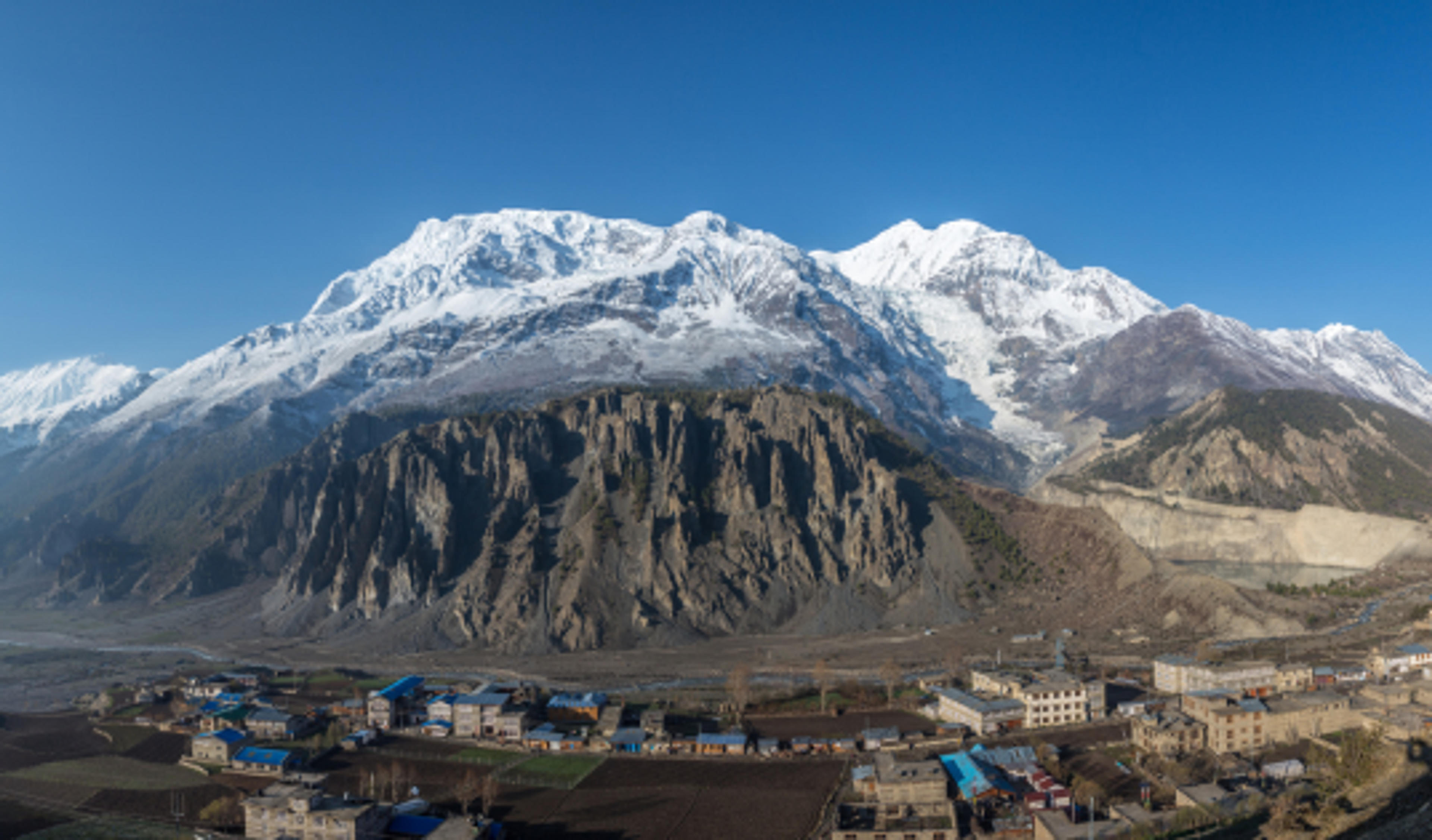
    Manangis a high-altitude village on the Annapurna Circuit, sitting at roughly 3540 metres and serving as a key acclimatisation stop before the Thorong La Pass crossing. Surrounded by Annapurna II, Annapurna III, Gangapurna, and Tilicho Peak, its stark, arid landscape contrasts with the lush lowlands trekkers pass through earlier on the route. Nearby attractions include the turquoise Gangapurna Lake and old monasteries built into the cliffs. As one of the most striking high-altitude places of Nepal to visit, Manang is both scenic and practical for acclimatisation.

    • Location: Manang District, Gandaki Province, within the Annapurna Conservation Area.
    • Timings: Best visited March-May and September-November; most travellers pass through as part of a multi-day trek.
  • Everest Base Camp

    Everest Base Camp

    Everest Base Camp, at the foot of the world’s highest mountain, is one of the most sought-after trekking destinations on the planet. The classic route followed with a flight to Lukla, followed by a multi-day trek through Namche Bazaar, Tengboche, and Dingboche before reaching the base camp itself. Along the way, trekkers pass Sherpa villages, monasteries, and increasingly dramatic Himalayan scenery. Despite its remoteness and altitude, it remains one of the most iconic places to visit in Nepal for adventure travellers worldwide.

    • Location: Solukhumbu District, within Sagarmatha National Park.
    • Timings: Best trekked March-May and September-November.

Frequently Ask Questions

First-time visitors generally do well starting with Kathmandu Valley's UNESCO sites, especially Bhaktapur and Kathmandu Durbar Square, followed by a couple of days in Pokhara beside Phewa Lake. Adding a short trek such as Ghorepani-Poon Hill and a wildlife safari in Chitwan rounds out a balanced first trip that covers culture, mountains, and nature without demanding high-altitude trekking experience. Most of these destinations connect easily by road or short domestic flights, making a 7-10 day itinerary comfortably achievable.

Plan your dream trip

Talk to our experts today!